
Understanding the business model, investment, revenue potential, operational costs and the realities of building a profitable preschool.
Opening a preschool can be a rewarding entrepreneurial journey. But is it actually a good business? Can a preschool generate sustainable profits? How long does it take to break even? And what separates a successful preschool from one that struggles to survive?
These are some of the most important questions aspiring preschool entrepreneurs should ask before investing their money.
India’s early childhood education sector offers opportunities for individuals who want to combine entrepreneurship with the creation of meaningful educational institutions.
However, there is an important distinction between identifying a promising sector and building a profitable business within it.
A preschool may operate in a growing residential neighbourhood, have attractive classrooms and offer a well-designed curriculum, yet struggle financially because of high operating costs, insufficient admissions or weak management systems.
Conversely, a thoughtfully planned preschool with an appropriate cost structure, capable teachers, strong parent relationships and consistent admissions can develop into a sustainable enterprise.
The real question is not whether preschools can be profitable. It is what makes a preschool profitable—and whether you are prepared to build and manage such an institution.
Let’s explore the economics of preschool entrepreneurship in India.
1. Why preschool education deserves the attention of entrepreneurs
Early childhood education occupies an important place in India’s educational landscape.
The National Education Policy 2020 recognises the foundational stage, covering ages 3–8, as a crucial period of learning and development. This includes three years of preschool education followed by Grades 1 and 2.
The National Curriculum Framework for Foundational Stage, introduced in 2022, reinforces the importance of high-quality, play-based and developmentally appropriate early learning.This recognition creates an important opportunity for responsible education providers.
Parents increasingly have reasons to evaluate the quality of early learning environments, the qualifications of educators, school safety, communication standards and the overall developmental experience.
However, demand for preschool education should not be confused with guaranteed demand for a particular private preschool.
Every neighbourhood has its own economic characteristics, demographics, competing institutions and parent expectations.
A successful entrepreneur must understand these local factors before making an investment.
2. Understanding the preschool business model
Unlike many retail businesses, a preschool operates primarily on an enrolment-driven revenue model.
The financial performance of the institution depends on the number of children enrolled, the fees charged, the cost of delivering educational services and the efficiency of operations.
A typical preschool can have several potential revenue streams.
A. Preschool tuition fees
Tuition fees generally constitute the primary revenue source.
Depending on the institution, these may be collected monthly, quarterly, term-wise or annually.
Preschools typically offer programmes such as Playgroup, Nursery, Junior KG and Senior KG.
The fee structure depends on several factors, including:
– City and micro-market.
– Brand positioning.
– Curriculum and learning environment.
– Quality of infrastructure.
– Teacher-to-child ratios.
– Programme duration.
– Competing preschool offerings.
A well-positioned preschool should build its fee structure around the value it delivers and the affordability of its target parent community.
Charging the highest fee in the neighbourhood is not necessarily the best strategy.
B. Daycare services
Daycare can be an additional revenue opportunity, particularly in locations with demand from working parents.
A preschool may operate for a limited number of instructional hours, whereas daycare services can extend across a larger portion of the day.
This creates opportunities to serve families seeking both early childhood education and supervised care.
However, daycare requires additional staffing, safety arrangements, meals and rest facilities where offered, extended operating hours and careful supervision.
It should therefore be treated as a separate service with its own cost structure, rather than as automatic additional profit.
C. Holiday camps and enrichment programmes
Some institutions may offer optional activities during school holidays or outside their regular preschool programmes.
Examples include summer camps, storytelling workshops, arts and crafts programmes and age-appropriate enrichment sessions.
Such services may provide supplementary revenue while strengthening relationships with families.
However, they should remain consistent with the institution’s educational philosophy, safeguarding standards and contractual commitments.
D. Registration fees and learning materials
Depending on the preschool model, registration charges, educational kits and other approved fees may contribute to total collections.
Entrepreneurs must distinguish between genuine operating revenue and amounts collected to cover specific materials or services.
A school with several revenue streams is not necessarily more profitable. Profitability depends on how much remains after the full cost of delivering those services.
3. What does it cost to operate a preschool?
This is where many first-time entrepreneurs underestimate the complexity of the business.
Setting up a preschool involves one-time investment, but maintaining it requires continuous expenditure.
The major operating costs generally include:
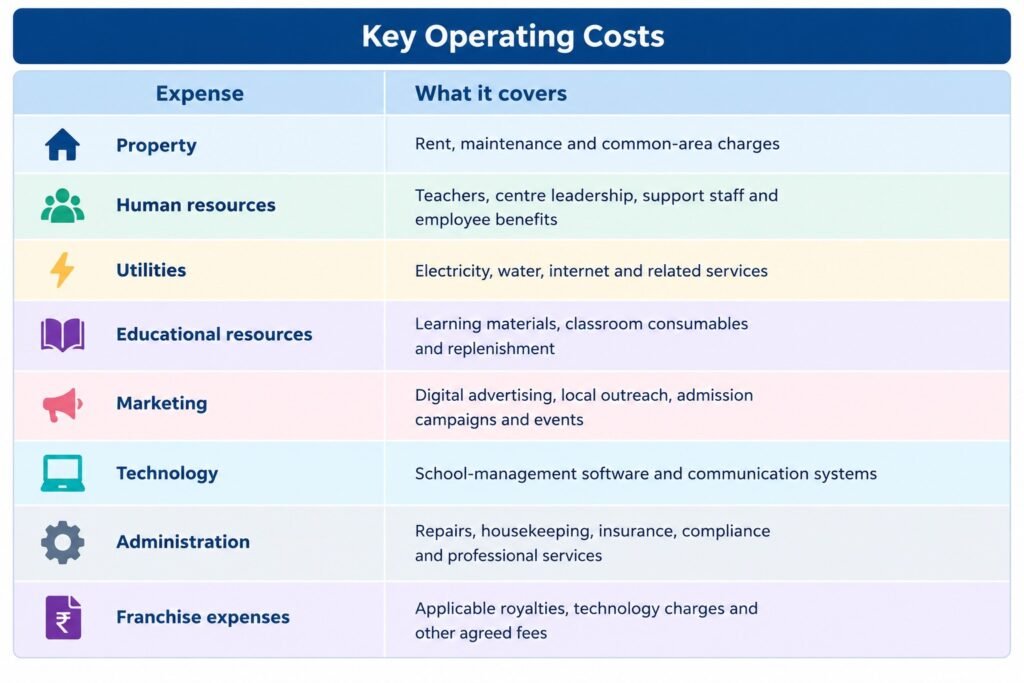
Among these, rent and salaries are often particularly important because they continue even when student enrolment is below expectations.
Consider a preschool that has been designed to accommodate 100 children.
Whether it initially enrols 30 children or 70 children, the property rent may remain unchanged.
The institution also requires minimum staffing levels, administrative support and essential infrastructure.
This creates a significant financial challenge during the initial admission-building period.
A preschool’s ability to control fixed costs without compromising educational quality plays an important role in its long-term financial sustainability.
4. How much revenue can a preschool generate?
To understand the business opportunity, let’s examine a simplified financial illustration.
Assume a preschool charges an average annual tuition fee of ₹60,000 per child.
The following table demonstrates how enrolment influences annual tuition revenue.
Illustrative annual tuition revenue
₹0 lakh ₹20 lakh ₹40 lakh ₹60 lakh ₹80 lakh 40 children 60 children 80 children 100 children
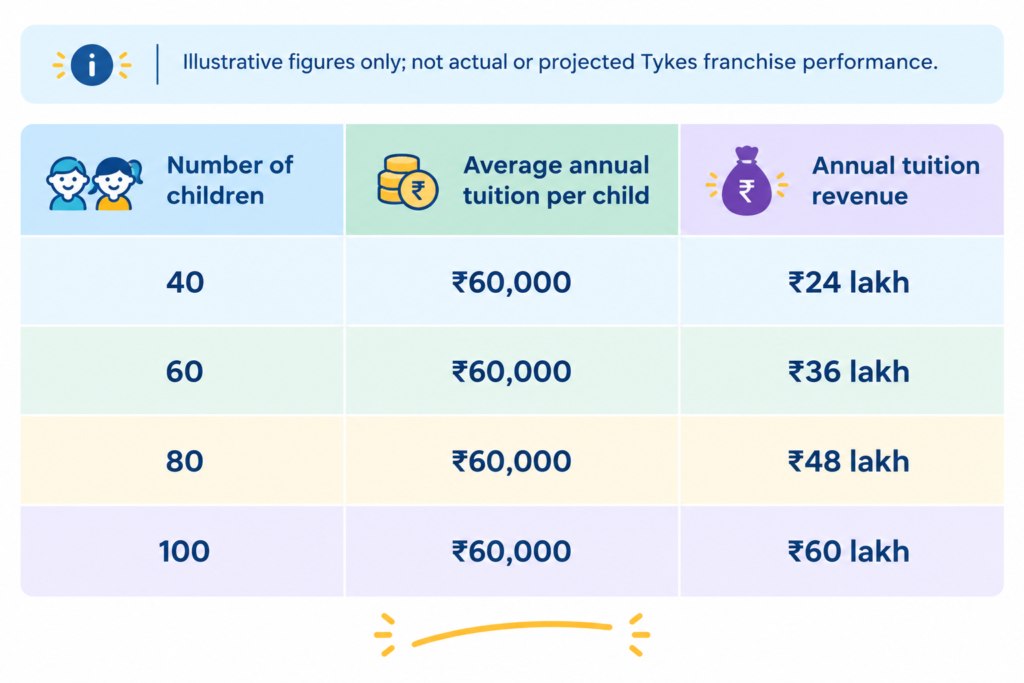
These figures illustrate gross tuition revenue—not profit.
Actual average revenue may differ due to programme mix, discounts, concessions, withdrawals, collection patterns and the number of months children attend.
The example also assumes enrolment throughout the relevant fee period. A centre admitting students gradually during the year may generate less revenue.
Additional income from daycare or other services has deliberately been excluded.
5. The most important question: When does a preschool break even?
Every aspiring preschool owner should understand the concept of break-even.
A preschool reaches operating break-even when its operating revenue is sufficient to cover its operating expenses.
Let’s consider a hypothetical preschool with the following annual cost structure.
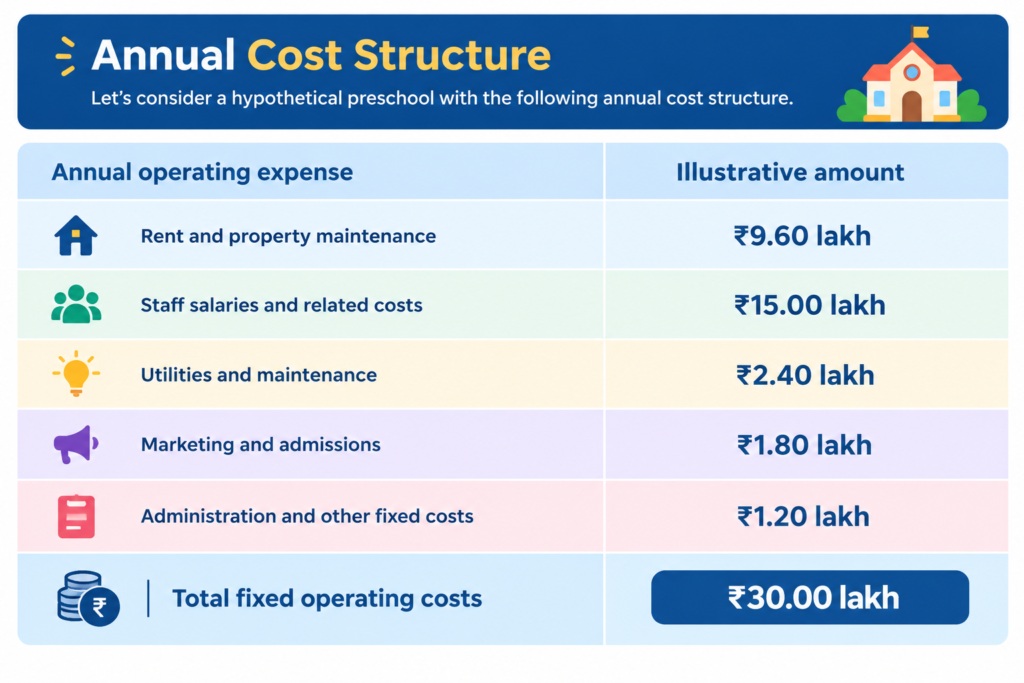
Assume:
– Average annual tuition revenue: ₹60,000 per student.
– Variable expenses, including applicable per-student materials and charges: ₹10,000 per student.
– Annual contribution per student: ₹50,000.
Under these assumptions:
Break-even enrolment = Annual fixed costs ÷ Contribution per student
₹30,00,000 ÷ ₹50,000 = 60 students.
In this illustration, the preschool would need approximately 60 full-year-equivalent student enrolments to cover the specified operating costs.
Let’s examine different scenarios.
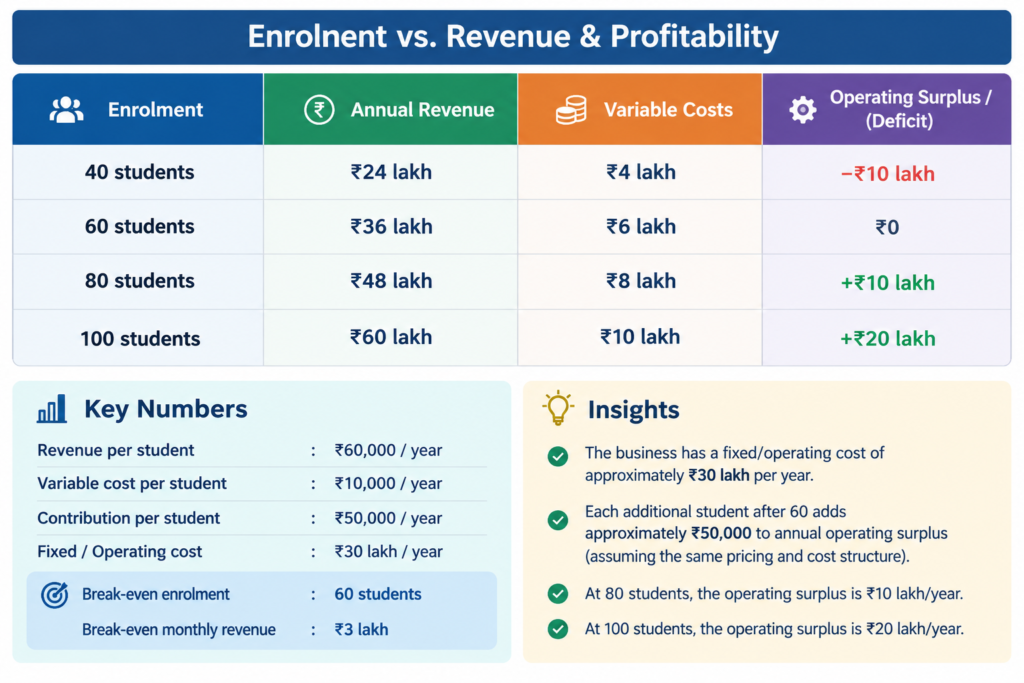
(These are purely hypothetical illustrations, not Tykes franchise projections or industry averages. They assume fixed costs remain unchanged throughout the enrolment range and exclude financing costs, depreciation, income tax, owner remuneration unless already included, initial investment recovery and any unmodelled contractual charges. Actual staffing and infrastructure costs can increase as enrolment grows.)
This example highlights a crucial characteristic of the preschool business.
Admissions growth can significantly improve operating performance once the institution has covered its fixed costs.
However, the reverse is equally important.
If enrolment remains below the break-even threshold, operating deficits can accumulate.
That is why enrolment forecasting, working-capital planning and cost management are essential.
It is also important to distinguish operating break-even from recovering the original investment. A school can cover its annual expenses and still take several years to recover its initial setup expenditure.
6. Why location can determine the success or failure of your preschool
A preschool is fundamentally a neighbourhood-driven business.
Unlike a destination school where parents may be willing to travel considerable distances, convenience and accessibility often play a significant role in preschool selection.
Parents generally prefer institutions that fit comfortably into their daily routines.
Before selecting a property, an aspiring preschool entrepreneur should conduct a detailed catchment-area study.
Important considerations include:
Residential population: Are there sufficient families with children in the relevant age group?
Competition: How many preschools already operate in the catchment? What are their fees, programmes and perceived strengths?
Parent affordability: Does the proposed fee structure match the neighbourhood’s spending capacity?
Accessibility: Is the location convenient, safe and reasonably accessible?
Growth potential: Are new residential projects likely to influence the local market over the coming years?
Property economics: Is the rent sustainable relative to realistically achievable admissions?
A property with attractive interiors but limited residential demand may be a poor business decision.
Similarly, a rapidly developing neighbourhood can present opportunities, but future housing occupancy should not be treated as guaranteed immediate demand.
One of the most valuable exercises an entrepreneur can undertake is to estimate the realistic number of children the preschool can attract during its first three admission cycles.
That projection should drive the investment decision—not merely optimism about future growth.
7. The seven biggest financial risks in the preschool business
Like every entrepreneurial venture, preschool ownership involves risk.
Understanding these risks is essential before investing.
Risk 1: Overestimating admissions
A preschool with capacity for 100 children will not necessarily enrol 100 children.
New institutions often need time to establish local visibility, credibility and parent confidence.
Preparing financial projections based on full capacity from the first year can create unrealistic expectations.
Risk 2: Overspending on infrastructure
Attractive classrooms and quality infrastructure matter.
However, entrepreneurs sometimes spend disproportionately on interiors and decoration while leaving insufficient funds for marketing, staffing and working capital.
The objective should be to create a safe, functional and stimulating environment—not simply the most expensive one.
Risk 3: High fixed operating costs
An expensive property can consume a significant share of revenue.
Similarly, an inefficient staffing structure can place pressure on financial performance.
The challenge is to create a cost-efficient operating model while maintaining adequate staffing, safeguarding and educational standards.
Risk 4: Inadequate working capital
Even a promising preschool may take time to reach operating break-even.
Entrepreneurs should plan for the possibility of lower-than-expected admissions, delayed fee collections and unexpected expenses.
Working capital is not an optional component of the investment plan.
Risk 5: Weak admissions management
Generating enquiries is only one part of the admissions process.
The institution must also respond promptly, understand parent requirements, conduct effective school visits and maintain appropriate follow-up.
Poor enquiry management can lead to missed opportunities despite substantial marketing expenditure.
Risk 6: Compromising educational quality
Trying to reduce costs by compromising teacher quality, supervision, training or educational resources can damage parent confidence.
This may affect retention, recommendations and the institution’s long-term reputation.
Risk 7: Treating the preschool as a passive investment
A preschool is not simply an asset that begins generating returns once it opens.
It is an operating institution that requires regular attention to people, quality, finances, parent relationships and compliance.
Even with professional management, the owner must ensure clear accountability and oversight.
A preschool may be a promising business opportunity, but it is rarely a business that succeeds through passive ownership alone.
8. What separates profitable preschools from struggling ones?
While financial performance varies across institutions, several operational disciplines can contribute to sustainable profitability.
1\. Strong admissions systems
Successful operators carefully manage enquiries, school visits, follow-ups, conversions and admissions forecasts.
2\. Consistent academic quality
A meaningful curriculum, capable teachers and engaging learning experiences help establish parent trust and retention.
3\. Financial discipline
Effective budgeting, cost monitoring and cash-flow management help owners make informed decisions.
4\. Parent satisfaction and referrals
Positive relationships can encourage recommendations and help strengthen an institution’s local reputation.
In addition, sustainable operators invest in staff development, clear operating procedures, child safety, technology-enabled administration and continuous improvement.
A well-managed preschool does not rely on admissions alone. It works to create an environment in which families want to continue their association and recommend the institution to others.
9. Independent preschool or franchise: Which makes better business sense?
One of the most important decisions aspiring entrepreneurs face is whether to launch independently or partner with a preschool franchise.
An independent preschool provides greater control over brand identity, curriculum, fee structures and operational decisions.
However, it also requires the owner to develop systems, learning programmes, marketing capabilities and training processes from the beginning.
A preschool franchise may provide access to an established brand, academic resources, infrastructure standards, training and operational support.
The commercial trade-off often involves franchise fees, recurring royalties and contractual restrictions.
The better financial choice depends on the investment, ongoing obligations, quality of support and the owner’s capabilities.
Before selecting a franchisor, ask:
– What is the complete investment, including working capital?
– What recurring charges will apply?
– What academic and operational support is actually provided?
– How will the franchisor assist with location evaluation and launch planning?
– What systems exist for teacher training and parent communication?
– What do existing franchise partners say about their experience?
– What responsibilities remain with the franchise owner?
A good franchise relationship should be evaluated as a long-term business partnership rather than merely a licence to use a brand name.
10. Why operational experience matters when selecting a franchise partner
There is an important distinction between understanding how to franchise a preschool concept and understanding how to operate a preschool every day.
Running an educational institution requires continuous decisions involving teachers, parents, infrastructure, safety, academic quality, marketing, admissions and finances.
Experience in addressing these everyday operational challenges can be valuable when designing a franchise support system.
At Tykes Early Years, our approach draws upon the experience of building and operating Kidzonia International Preschools.
This experience has helped shape our understanding of what preschool entrepreneurs need beyond curriculum and branding.
It includes the importance of structured processes, continuous teacher development, admissions planning, operational oversight and a consistent educational experience.
We believe that a preschool franchise should provide entrepreneurs with access to knowledge and systems that help them navigate the practical challenges of managing an early-learning institution.
However, irrespective of the franchise brand selected, investors should independently evaluate contractual terms, operational commitments and financial assumptions before making a decision.
11. Is a preschool business suitable for you?
Preschool entrepreneurship can appeal to educators seeking institutional ownership, professionals considering entrepreneurship, individuals exploring a career transition and investors interested in the education sector.
However, the business is most suitable for entrepreneurs who recognise that education is a responsibility as well as a commercial activity.
Before investing, ask yourself five questions:
1. Am I genuinely interested in building and managing an educational institution?
2. Do I have adequate capital for both setup and the initial operating period?
3. Am I willing to participate in business development, people management and operational oversight?
4. Have I researched the local preschool market thoroughly?
5. Do I understand that financial returns are uncertain and depend on execution?
If the answers are largely positive, preschool entrepreneurship may deserve serious consideration.
If the objective is simply to invest money and receive predictable passive income, the business may not be an appropriate fit.
12. The long-term opportunity: Building an institution, not just a business
Perhaps the most distinctive feature of preschool entrepreneurship is that business performance and educational quality are closely connected.
A good preschool builds trust.
Trust strengthens parent relationships.
Positive experiences can lead to recommendations.
A strong local reputation can support admissions over time.
And consistent admissions, when combined with an appropriate cost structure, can contribute to financial sustainability.
This creates an opportunity to build something that has both economic value and meaningful educational impact.
But that outcome is earned through planning, investment, responsible management and a continuous commitment to quality.
Conclusion: So, is starting a preschool a good business opportunity in India?
Yes, starting a preschool can be a promising business opportunity in India—but profitability is neither automatic nor guaranteed.
The sector benefits from the importance placed on early childhood education and the continuing need for quality learning environments.
However, the success of an individual preschool depends on local demand, investment discipline, admissions, fee positioning, teacher quality, parent confidence and operational efficiency.
For aspiring entrepreneurs, the objective should not simply be to open a preschool at the lowest possible investment.
It should be to create an institution capable of delivering quality education while operating on a financially sustainable model.
At Tykes Early Years, we believe that responsible preschool entrepreneurship begins with informed decisions, realistic financial planning and a commitment to creating meaningful early-learning experiences.
Because ultimately, a successful preschool is not built merely by enrolling children. It is built by earning the trust of families, empowering educators and creating experiences that make a difference.
EXPLORE PRESCHOOL ENTREPRENEURSHIP
Build a Preschool. Build a Brighter Tomorrow.
Interested in exploring preschool entrepreneurship with structured academic and operational support?
Learn more about partnership opportunities with Tykes Early Years, supported by the experience of Kidzonia International Preschools.