
Is My Child Ready for School? The Question We’re All Asking Wrong
Every year, as school admission season arrives, parents across the country ask themselves a version of the same anxious question: Is my child ready? Can they sit still long enough? Do they know their alphabet? Will they be okay without me?
It’s a question born of love — and it deserves a much more nuanced answer than we usually give it. Because “school readiness” is not a single thing. It’s not a checklist. And it’s certainly not just about whether a four-year-old can recognise letters or count to twenty. It is, in fact, a much richer and more hopeful concept than most of us realise.
What school readiness actually means
Developmental researchers broadly define school readiness across five domains: physical health and motor development; social and emotional development; approaches to learning; language development; and cognitive development and general knowledge. Of these five, social-emotional development and “approaches to learning” consistently emerge as the most predictive of long-term school success — and yet they’re the two areas least addressed by typical “school prep” strategies.
A child who can count to a hundred but bursts into inconsolable tears when asked to wait their turn is going to find school considerably harder than a child who can count to ten but knows how to ask for help, express their feelings, and take turns with a friend. Academic content can always be taught. Emotional regulation and social confidence are built over years — and the early years are precisely when this building happens most naturally.
The role of early childhood education
High-quality early childhood education is one of the most evidence-backed interventions in all of developmental science. Study after study — including the landmark Perry Preschool Project and the Abecedarian Project — has shown that children who experience rich, nurturing, play-based early education have measurably better outcomes across their entire lives: higher graduation rates, stronger earning potential, better physical health, and lower likelihood of experiencing significant difficulties.
What separates high-quality early education from mere childcare is the intentionality of relationships. A warm, responsive educator who knows a child well, who notices when they’re struggling and when they’re soaring, is doing something no app or curriculum can replicate.
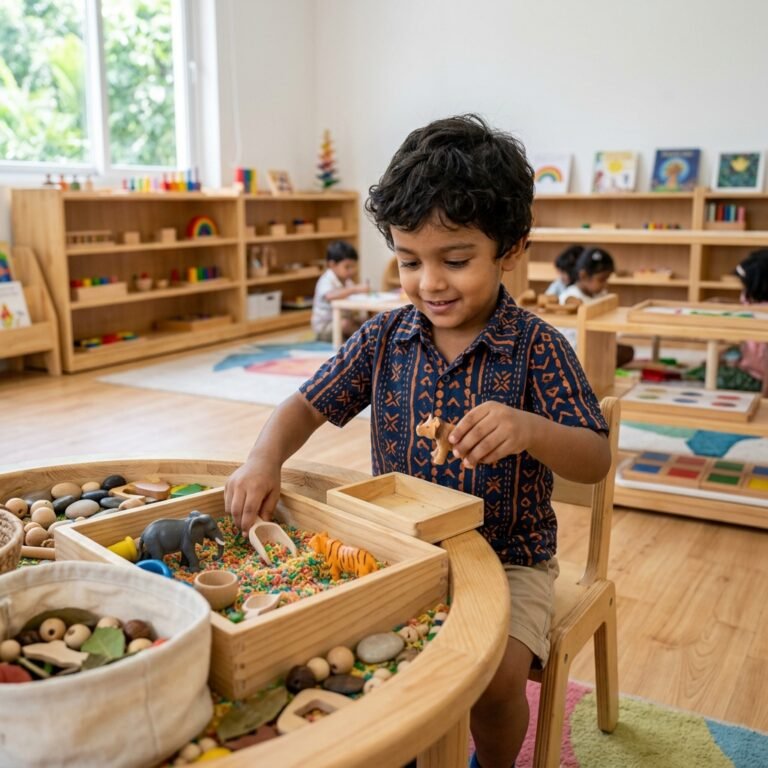
This doesn’t mean every child needs a formal preschool setting to thrive. A rich home environment, with responsive caregivers, language-saturated days, and plenty of play, can be equally nourishing. But for many families, a thoughtfully designed early years programme provides both the social experience and the structured enrichment that accelerates development across all domains.
The red flags we miss — and the ones we imagine
Parents often worry about the wrong things. They worry that their child doesn’t know enough letters, when what actually warrants attention is whether their child can make eye contact, engage in back-and-forth conversation, or recover from disappointment within a reasonable time. Meanwhile, genuine early indicators of difficulty — persistent difficulties with language comprehension, significant sensory sensitivities, or a complete preference for solitary play — are sometimes explained away as “just a phase.”
The goal is not to pathologise normal childhood variation. The goal is to pay the kind of warm, thoughtful attention to a child that allows us to notice when they might need extra support — and then to provide it, without shame, without drama, and without delay.
Practical ways to build readiness at home
The most effective school readiness preparation happens not in workbooks, but in daily life. Routines build the sense of predictability and security children need to feel confident facing new situations. Conversations — real, extended conversations where a child’s ideas are taken seriously — build language, reasoning, and the confidence to speak up. Play with other children builds the social skills that make classroom life possible.
Specific practices that research consistently supports: reading aloud every day (not just books — menus, signs, packaging — everything is text); giving children small responsibilities that build a sense of competence; practising emotional naming (“you look frustrated — is it because the tower fell down?”); and allowing children to resolve small conflicts themselves before stepping in to solve it for them.
Perhaps most powerfully: model your own relationship with learning. When children see the adults in their lives being curious, admitting they don’t know something and looking it up, laughing at their own mistakes, and trying again — they learn that this is what learners do. And that is the most important thing they can bring to any classroom.
Starting school: the first transition
For many children, starting school is their first significant experience of a world beyond home. It can be exhilarating and terrifying in equal measure. Separation anxiety is normal. So is a period of regression — some children who have been reliably toilet trained for a year will have accidents in the first weeks of school. Some children who are chatty and confident at home will be silent at school for weeks.
The most helpful thing parents can do during this transition is to stay calm (children are exquisitely sensitive to adult anxiety), maintain predictable home routines, and trust the process. The discomfort of the first transition is also the first rehearsal for resilience — and navigating it, with loving support, is itself a developmental achievement.