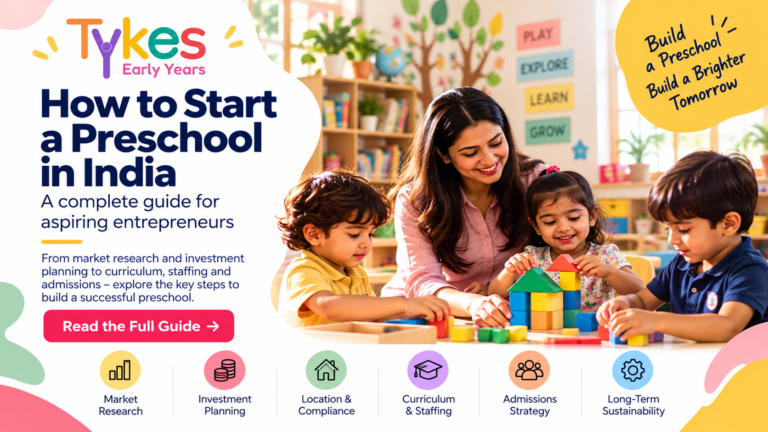

Why Play Is the Most Serious Thing a Child Can Do
There’s a moment every parent recognises. Your child ignores the expensive toy you just bought and spends forty minutes playing with the cardboard box it came in. You laugh, maybe feel a little exasperated — and then you watch in quiet wonder as they construct a spaceship, a cave, a kingdom, entirely from nothing. What you’re witnessing in that moment isn’t a child wasting time. It’s a child doing the most important work of their life.
Play is how young children understand the world. It is the medium through which they learn language, build emotional intelligence, develop problem-solving instincts, and form their first ideas about who they are. Decades of research in developmental psychology confirm what parents have always sensed intuitively: play isn’t what children do when they’re not learning. Play is how children learn.
The science of play-based learning
When children engage in free, imaginative play, their brains are extraordinarily active. The prefrontal cortex — the region responsible for planning, decision-making, and social behaviour — develops rapidly during play scenarios. Children who play cooperatively with others practise reading facial expressions, regulating their emotions, and negotiating — skills that no worksheet can teach.
Researchers at the University of Cambridge found that children who had more unstructured play time in their early years showed significantly better self-regulation by age seven. Self-regulation — the ability to manage impulses, focus attention, and persist through difficulty — is one of the strongest predictors of academic and life success, outperforming IQ in many long-term studies.
Not all play is created equal
There’s an important distinction between passive entertainment and active, engaged play. Screen time that requires a child to only watch and react is fundamentally different from building with blocks, enacting a story with friends, or exploring a garden with a magnifying glass. The most developmental form of play is self-directed and imaginative — where the child is the author, not just the audience.
At Tykes, our classrooms are designed around the idea that the best learning environments feel a little like a very well-curated playground — full of invitation, wonder, and just enough structure to let children feel safe enough to take risks.
How parents can nurture play at home
You don’t need special equipment or elaborate setups. Some of the richest play happens with the most ordinary materials. A bowl of water and some cups. A pile of leaves. A handful of different-sized boxes. The key is to resist the urge to direct. When a child is deep in imaginative play, your job as the adult is simply to protect the time and space — and occasionally, to be invited in.
Ask open questions: “What’s happening in your city?” “What does your character need next?” rather than “What are you making?” The first two extend the child’s own narrative; the last one redirects it to yours.
Play and early literacy
Play is also a profound gateway into language. Children who engage in rich pretend play develop significantly larger vocabularies than those with limited play opportunities. When a child narrates their own play — “and then the dragon flew over the mountain and he was so tired” — they are practising complex sentence structure, storytelling, and sequencing. That’s the direct precursor to reading comprehension.
Dramatic play, in particular, gives children a safe space to try on emotional experiences they may not yet have words for. The child who is shy in a group might become a confident superhero in play. That imaginative rehearsal builds real-world confidence over time.
The case for protecting play time
In an era of accelerating academic pressure, there is a growing temptation to replace free play with structured learning activities — flashcards, coding apps, early phonics drills. The instinct is understandable. Parents want to give their children every advantage. But the research is clear: children who lose play time to premature academic instruction don’t gain long-term academic advantage. They often lose it.
The children who thrive in school are those who arrive with a sense of curiosity, a tolerance for challenge, and the social skills to collaborate and communicate. Play builds all three. Worksheets, on their own, build none.